Paradise Regained

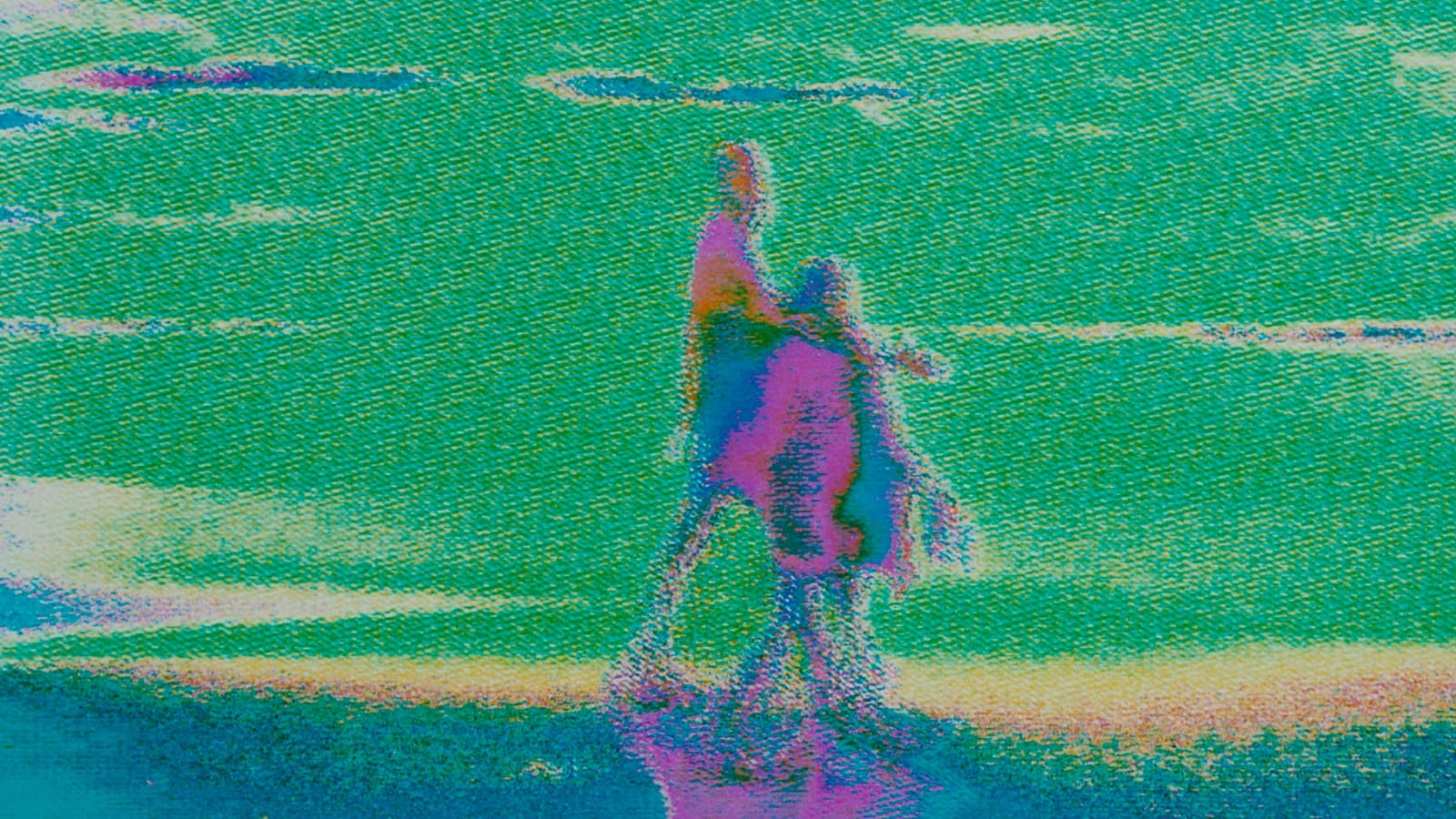
In Until the End of the World, Wim Wenders’ mind-bending 5-hour science fiction epic, the protagonist, Claire, wakes up amidst the remnants of a decadent party in Venice and decides to drive home to Paris. She soon hits traffic. The world is apparently ending. A nuclear satellite has gone rogue and may soon collide with the earth, ushering in the apocalypse. Claire realizes that there is opportunity in this impending crisis: she can wipe the slate clean—start her life over and make meaning for herself. This is 1991 and the end of history is upon us. Caught up in international intrigue, Claire soon hops effortlessly across the globe, from Moscow to San Francisco to the Australian desert. The world is her oyster until it catches up with her.
I thought of Claire while I was watching Sirât, Oliver Laxe’s 2025 Cannes Prix du Jury winning film. Although Sirât has mostly been described as a road movie, it is maybe more accurately a journey to nowhere. Like Claire, the characters in Sirât move blithely across contested borders and through unfamiliar landscapes, ignoring reports of global crisis, until everything comes crashing down on them.
Until the End of the World and Sirât share this blissful escapism and a fascination with remote, seemingly inhospitable landscapes, but they are very different genre-wise. I have seen Siråt compared to Mad Max, Wages of Fear/Sorcerer, and other such voyages through hell. But it contains a purposelessness and a sense of drifting that those films lack. It is more spiritual, in the kind of new age-y vein that its director emanates. “Sirat” is an Arabic word, apparently referring in Islamic theology to a very narrow bridge that leads souls to paradise. On either side of the bridge yawns the abyss of Hell. You must walk very carefully and straight ahead to reach the other side without falling. This imagery recurs in literal sequences during the film, although their meaning is not entirely straightforward. Where is hell in this movie? Is it in this collapsing world or in an escape from it? In the stunning opening sequence, during a freetekno rave in the desert, lasers form a glowing staircase leading up the sheer cliffs like a stairway to heaven. The thudding and minimalist beat in the background winds its way up to ecstasy. Dance becomes something ritualistic, religious even. It binds people and individuates them and exposes them to each other.
In the midst of this rave in the Moroccan desert, Luis (Sergí Lopez) appears with his young son. They are on a quest for his missing daughter, Mar, although it is unclear if she is really missing or has simply cut off contact with her family. Luis is preppy-looking and drives a minivan. He is clearly out of place in this scene. Still, he falls in with a group of ravers, convinced that they can lead him to his missing daughter. You get the sense that he recognizes something of her aura in them. But immediately after, the rave is shut down by a convoy of soldiers, who forcefully evacuate everyone. War has broken out, which the characters refer to ominously as “World War Three.” “It’s the end of the world,” quips Leo Goldsmith in his review for 4Columns, “and our children are at the rave.”
A few of the dancers are not deterred. A close-knit friend group of kind-hearted outcasts evade the soldiers and head out across the mountains, with Luis in tow, south towards “the Mauritania border.” Techno music ripples through the background, lending a hallucinatory quality to the gorgeous and bare mountain peaks and sandstorms. But this journey is a nightmare, pocked with extreme trauma and terror. It functions as a kind of ego death for Luis, who eventually wanders off in a numb fugue state and collapses beneath a blood-red sunset. He awakens stripped of everything—his belongings, his loved ones, his identity, like a modern-day Job, and is ultimately able to walk forward calmly, putting his faith in the unknown.
This final portion of the film, the section of it which most closely resembles a post-apocalyptic thriller, is seemingly set in the disputed territory of Western Sahara, which lies between Morocco and Mauritania. Laxe never explicitly mentions Western Sahara or the ongoing conflict between the Polisario Front and the government of Morocco and the geopolitical context is perhaps more readily legible to Spanish viewers. Most of the American reviews I read of the film barely mentioned it, instead seeing the violence that flares up as a far-off dystopian war.
Yet the context seems key to me to understanding the film, particularly its inclusion of land mines. Western Sahara has been a disputed territory since the 1970s, largely occupied by the Moroccan government, with the exception of a small breakaway zone. The UN has called it the last colony in Africa and much of its displaced population live in semi-permanent refugee camps in Algeria. Starting in the 1980s, the Moroccan government constructed a 1700 mile sand wall to form a buffer zone between Moroccan-controlled territory and the rest of Western Sahara (known as the Free Zone). Along this wall runs a nearly continuous minefield stretching out through the Sahara desert, sometimes for miles beyond the wall itself, and containing in total millions of buried land mines.
In Sirât, the characters will eventually stumble upon this minefield, while resting and grieving. They set up their own impromptu rave before realizing they are in a death trap. The whole film is crystallized, I think, in this moment. Suddenly, instead of Mad Max, the story and its delicate thumping soundtrack, resembles something like Zone of Interest. There is death all around but all they can do is dance. A.S. Hamrah sums it up pithily in his n+1 review, remarking that the characters “try to submerge themselves in a subculture in the middle of nowhere, but the world’s violence will catch up to them.”
Eliding this political context in favor of a vague symbolic war is frustrating and has been justifiably criticized, but it allows Laxe to leave open a symbolic reading of the film, overlaying the literal one. Luis and his companions walk through the valley of the shadow of death. They are stripped, rave-like, down to pure feeling and survival. They take psychoactive drugs which help speed up their ego death. The film offers a critique of its protagonists, a group of marginalized European punks who believe they can defeat nature and outrun global crisis, and who treat a contested colony as their playground. But it also empathizes with them. Raving will not save them, but it will bring them closer together, and maybe that is all they have left.
Claire too undergoes ego death in Until the End of the World. In Australia, on Arrernte Land, she becomes addicted to a device that can record your dreams and play them back for you in fuzzy abstract sequencing. In these recordings, she sees her past self, she sees her fantasies, she sees the faces of those who have died. Like the raves in Sirât, the dream recordings are a pastiche of spirituality and they blind Claire to the real world around her. She has escaped too far into the recesses of her own mind.
It has become very fashionable to talk about the end of the world as if it is imminent. This looming apocalypse is a putrid brew of the climate crisis, nuclear anxiety, techno-determinism, and millenarianism. Our current crop of dystopian film and fiction often hearken back to the mid-century, repurposing the fallout tropes of nuclear winter and sentient supercomputers to terrify audiences. In his 1993 book, Life under a cloud: American anxiety about the atom, Allan M. Winkler describes how difficult it was to spark and sustain public outrage and action around the Cold War nuclear arms race. “Unless issues become immediate […] most citizens of the United States have avoided thinking about vexing nuclear controversies in the naive hope that problems will simply disappear.” Instead, this anxiety was diverted into fiction. Winkler quotes Isaac Asimov who claimed that “atomic-doom science-fiction stories grew to be so numerous that editors began refusing them on sight.”
Part of the problem with dystopian stories, from climate fiction (cli-fi) to nuclear apocalypse to alien invasion to Black Mirror-esque social hell, is that they tend to take one of two narrative routes. Either, their protagonists languish in the knowledge of impending doom, trying to reckon with the smallness and insignificance of their lives and the magnitude of their feelings and their guilt around not having done more. Or, they improbably rise to the occasion and become heroes, averting catastrophe. A third way, humans trying to figure out how to adapt and survive through the destruction of their entire lifeworlds, is rarer but more interesting to my mind. In The Parable of the Sower, Lauren Olamina tries to rebuild her community in the face of intense destruction. In Station Eleven, the survivors of a flu pandemic form cooperatives and band together around art and theater, the only means of expression that is left to them. In Samuel Fisher’s novel, Migraine, set in a weather-ravaged London, a bookseller stays in his abandoned store, surrounded by now useless books, like some kind of latter-day Miss Havisham, until human connection pulls him out.
“The problem of the end of the world is always formulated as a separation or divergence,” write Déborah Danowski and Eduardo Viveiros de Castro in their book The Ends of the World. On the one hand, we imagine a world where our species has been wiped out and only the most tenacious of animals persist; on the other, we imagine humans left to wander an unrecognizable landscape, our entire world vanished. This second scenario is more easily imaginable perhaps than the first. We cannot imagine a non-human world, one animated by other forms of consciousness. In stories where humans have been replaced, such as Do Androids Dream of Electric Sheep? or Planet of the Apes, the animals are anthropomorphized or transformed into humanoid machines (Danowski, de Castro, pp. 65-66). In Western metaphysics, the natural world does not have consciousness. It waits passive, wild, untilled for the domination of Man.
Not all creation myths start at the beginning. De Castro and Danowski describe a series of Amerindian creation stories, notably that of the Yawanawa from the Western Amazon, in which humans are created before the rest of the natural world. However, these early humans engage in cruel and immoral behavior and squander their lives. Because of this, a great number of them change or are transformed into animals, plants, and the cosmos, thereby forcing the remaining humans into a kind of ontological relativity. Instead of a fall from grace or being granted dominion over the earth as in the Biblical tale, humans here exist in a world in which everything has consciousness and everything may endure after you are gone.
This upsets the Edenic story with its womb-like characteristics. In The Dawn of Everything, Graeber and Wengrow question our ability to really understand the movement of history, as attached as we are to the linear mythology of the Garden of Eden. In the Biblical version of creation, humans used to live in a magical pastoral paradise, eating fruits from the trees and sharing harmony with nature, before they were forced into the yoke of civilization. This is a bittersweet tradeoff. They will gain knowledge, which will allow them to develop laws and technology and art and agriculture, but they will continue to yearn for this simpler past when they were free from responsibility and toil and pain.
The problem with the Eden story for Graeber and Wengrow is that it infantilizes our ancestors (and, by extension, cultures organized differently than our own). Indeed, Bruce Pascoe describes in his seminal book Dark Emu how early British colonists arriving in Australia misrecognized the culture before them, identifying built structures, dams, flour storage units and artistic works as natural formations. So committed were they to the idea of the Aboriginal people they encountered as wild hunter-gatherers with no civilization, living in permanent Stone Age state, that they literally could not see the culture before them.
Graeber and Wengrow argue that demystifying our prehistoric ancestors will open us up to alternative ways of organizing human society. Danowski and de Castro argue that we already live in a radically diminished world, one that, in some ways, has already ended. This offers us the opportunity to move backwards, against the relentless tide of historical progress towards a more sustainable way of life. Oliver Laxe expresses a similar idea in an interview with Interview Magazine: “We’re not at the end of the world. […] We are in a changing era. When an era changes, it’s not like a door—it’s a fade, two eras overlapping. That’s why sometimes the past appears inside the future.”
Is a rave the closest thing we have to transcendence? Some of the earliest recorded religious rituals involved dance, music, hallucinatory experiences, sometimes aided by psychoactive drugs. Techno emerged in Detroit out of Afrofuturist imagery and experimentation as well as the pared-back rhythms of funk and jazz. Drexciya famously invented an entire alternative history, one in which the unborn babies of enslaved Africans thrown overboard during the Middle Passage morphed into aquatic creatures and grew up to construct a magical underwater nation. This imaginary past also contains a more liberated future within it. It collapses time into a different scale, one both more intimate and more vast.
But this kind of music and this kind of dancing has a real political drive, as Aria Aber pointed out in a recent essay for The Yale Review. By contrast, raving now “increasingly seems like a space for Aristotelian catharsis, a space to briefly satisfy a desire for community and release before returning to normal life on Monday mornings, cleansed of the revolutionary impulse, utterly unchanged.” Sirât attempts to reconcile these two conflicting forms, the rave as party tourism and the rave as real spiritual transcendence. It falters along the way, particularly in its brutality. Several people I know who watched the film before me warned me that it was deeply upsetting and horrifying. I found it less nihilistic though than I expected. The shock stayed with me after I finished, but so did the expansive sense of yearning for meaning, for something larger than yourself, for a way forward.
Instead, everyone around me seems to be retreating. The dream devices Wim Wenders imagined in the ‘90s feel strangely prophetic. Now, thanks to AI, which is sucking up our clean water and polluting our air, each of us can cocoon into our own fantasy world, a choose-your-own-adventure version of reality. Anna Weiner wondered recently in The New Yorker if the limitless realities promised by AI are not a kind of magic show, offering what historian Michael Saler calls “secular enchantment.” They fulfill a human urge towards illusion and fantasy, towards the promise of something more out there, and offer us scripts to reconcile them with modernity. But like Claire’s dream recorder, what they really give you back is a distorted picture of your own desires. It is total wish fulfillment, total gratification, with no bottom except despair, psychosis, or even death. Is this not the end of the world? Or at least, an ending of a world?
This was a great read. Sometimes it is the slow realization that the old ways of meaning no longer hold, and people start reaching for transcendence, fantasy, or community to survive it.
whirlwind of a piece. until the end of the world has been on my criterion channel watchlist for months now and maybe now's the time to bite the bullet and sit down for the full 5 hours